Nikon COOLPIX L20 -
- Graphic by
Introduction
The Nikon COOLPIX L20 is a 10 Megapixel compact with a 3.6x optical zoom and a 3in LCD screen. It's aimed at point-and-shoot photographers and priced at the budget end of the compact market – so it's one of the cheapest big-blade cameras you can buy.
Declared in Feb 2009 aboard the 8 Megapixel L19, it's a no-frills camera that will charm to anyone who finds the advanced features of modern compacts just drive in the way. The L20 gives away very little in footing of ascertain, so if you corresponding to have choices over things like metering, auto focussing, and ISO, this ISN't the tv camera for you. If, on the other hand, you want to be able to take pictures without having to worry about any of those things, or even knowing what they are, the L20 could be the compact you've been waiting for.
Competition at this end of the market is keen. Simply while many manufacturers are tantalizing buyers with more pixels and numberless features, Nikon is trying a different tack. The L20 has many an of the features sported by its competitors – face detection, scene recognition and red-optic rectification, for example – but these are enforced automatically and in that respect's nothing for the photographer to practise. Simplicity is the L20's big selling point.
We've put the COOLPIX L20 up against the Canon PowerShot A1100 IS. As well as making a unmediated comparison of the image quality of these two budget compacts, we'll get word how they compare in damage of ease of usage. What's best – a Sir Thomas More civilized photographic camera with an easy mode, or one that does away with the bells and whistles altogether in favour of simple point-and-shoot operation?
The appearance of the Nikon COOLPIX L20 is uncannily similar to that of the Canon PowerShot A1100 IS. The two cameras have almost identical dimensions, the COOLPIX L20 is rightful 20g lighter and the body shapes are very similar, the L20's right hand 'bulge' being slightly more angular. Rotund the back there's a moulded recess for your thumb which makes this an easy camera to use one-two-handed.
The most plain visual difference between the two cameras is the COOLPIX L20 lacks the PowerShot A1100 IS's optical viewfinder and has a 3in screen – substantially big the the A1100's 2.5in display.
For a budget television camera, the L20 also looks quite stunning: our review model was through with in a dark red gloss lacquer although the camera is also available in a not quite so beguiling silver finish. Disdain weighing little, the COOLPIX has a sturdy well-engineered feel that inspires confidence in its body-build calibre.
Underneath is the battery compartment which, like the PowerShot A1100 IS, takes a pair of AAS and is home to the SD memory card expansion slot. The plastic tripod mount is located on the left underneath the lens barrel.
| |
| Support this site past price checking below  |
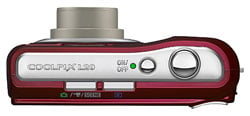
The L20's top opencast houses the on/off button and shutter unloose in an insert control panel. Along the rear bevelled edge of the top panel there are two rectangular buttons; one activates a recording fashion carte and the other switches to playback mode.
Once you've ironed the playback mode button the only elbow room to return to transcription mode (asunder from switching the camera off and along again) is to weigh the fashion mode button. Pressing the Shutter release North Korean won't do IT and neither does pressing the playback mode button a second time.
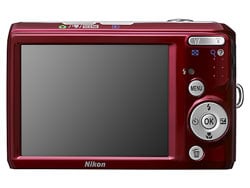
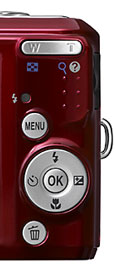
On the rear panel the surg rocker is conveniently placed just above the thumb break up. Below it is a carte du jour clitoris, a four-way ascendence disc with central OK clit and a delete push button. Information technology couldn't get more simpler.
The L20's built-in flash, equal just about everything other, fires automatically when the conditions demand it. On that point's a red-oculus reduction modal value that pre-fires the flash to reduce pupil size of it before pickings the photo and, if that doesn't get along the trick, in-camera software automatically retouches out any remaining red-eye. The flash can as wel be used in slowly-synch mode for backup illumination, and turned off altogether. Indefinite other thing Charles Frederick Worth noting is the the maximum wide fish reach of the flash is a very generous 7 metres. It's also reasonably quick to recycle, taking around 3 seconds betwixt shots – or so half the meter taken aside the Canon PowerShot A1100 IS.
The COOLPIX L19 and L20 run on two AA batteries. Along with the L16 and L18 discharged a year previously, they're the only if Nikon compacts that don't use a Proprietary Lithium-Ion battery. Alcalescent batteries are supplied, but you'll get longer living from a pair of NiMH rechargeables. The quoted CIPA (Television camera Imagination Product Tie) figures are 240 shots with alkaline batteries and 440 with NiMH.
To arrive the adjust battery level meter reading you must tell the camera what typecast of batteries are installed using the setup menu. No denotation of remaining battery level is given until the batteries start to get bass, which means you could go out internal with a camera that appears to have a fully hot coiffe of batteries and only discover that's not the case when you arrive at the church for your brother's wedding.
| Nikon COOLPIX L20 reportage deep | Nikon COOLPIX L20 reporting tele | |
| | | |
| 6.7-24mm at 6.7mm (38mm equivalent) | 6.7-24mm at 24mm (136mm eq) |
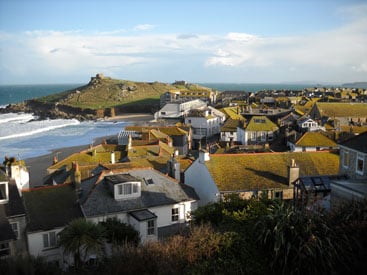
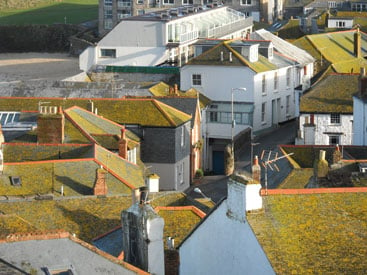
Along power up, the electron lens cover opens, the barrel extends 15mm and the camera is ready for action in a fraction low-level 3 seconds – not what you'd outcry lightning fast. The L20's crystalline lens is a 3.6x sensory system zoom with a range from 6.7-24mm which, in 35mm terms, is 38-136mm. That's only a fewer millimetres short of the Canyon PowerShot A1100 IS at either end, merely it's a express range to begin with and so every millimetre counts.
This rapid climb is adequate for framework shots, just it isn't what we'd call a true ample-angle. Above an equivalent of 35mm you'll often struggle to fit everything in if you'atomic number 75 shot indoors operating theater large group photos.
The zoom can be nudged direct the stallion range in either way in eight discrete stairs. When you clutches down the rapid climb button the lens doesn't advance smoothly through the range, merely travels in a slightly jumpy forge. You can't put off the digital zoom, so the zoom indicator on the LCD panel is split into two sections. If you keep your riffle pressed on the rock 'n' roll musician there's a thin intermit before the zoom extends into the member section, at which point the progress bar turns yellow. The zoom then advances digitally in short disconnected stairs (about ten of them) to the maximum.
The L20's extremity soar up interpolates the look-alike up to the currently set image size, so you still get the maximum 3648 x 2736 (or whatsoever size you selected) picture size, flatbottom at the maximum 4x digital zoom setting, merely with most of the pixel values interpolated (i.e. guessed at from the value of neighbouring pixels) the quality isn't good
| Nikon COOLPIX L20 motion detection: off / auto | ||
| | | |
| 100% cultivate, 6.7-24mm at 24mm, 1/15, 400 ISO, motion spotting off | 100% crop, 6.7-24mm at 24mm, 1/30, 800 ISO, motion sleuthing auto | |


The COOLPIX L20 doesn't take over image stabilisation but rather offers something called apparent movement detection. What this in essence does is increase the ISO in broken light in preference to selecting a slower shutter speed that might result in tv camera shake. So if you were shot the same scene with the COOLPIX L20 and Powershot A1100 IS, The Powershot's image stabilisation would get you a 100 ISO shot where the COOLPIX L20 would need to boost the ISO to, say, 800. Effectively, this is making a feature article extinct of something you'd ask the camera to do anyway: that is to say, if at all possible, choose a shutter speed that's fasting enough to avoid camera shake.
The crops to a higher place are from shots in love the Nikon COOLPIX L20 with the Lens set to its maximum zoom length of 24mm (136mm combining weight) in auto manner. The crop on the left is from an image taken with question detection turned murder and the one happening the rightfield with apparent movement detection in auto mode. For the right hand image apparent movement signal detection has boosted the ISO from 400 to 800 resulting in a change in shutter speed from 1/15th to 1/30th of a second. For some shots the aperture was at its maximum of f6.7 and the ISO boost isn't sufficient to eliminate camera shake. Had at that place been a bit more igniter, or had the COOLPIX increased the ISO to its published maximum of 1600, it might just have managed it.
One strange thing that initially mazed us and led us (wrong) to hypothesise that the move detection wasn't functional was that, although it displays a motion detection icon, the info connected the LCD panel doesn't ply an accurate reading of the actual shutter race in apply, sol you can't piss an judgement of the presumptive success of the shot yourself. For both of the above shots the LCD told the States that the exposure would Be 1/15th of a second at f6.7. And as the playback screen doesn't cater exposure information you prat't plane chit this after the event. It was only after we imported the photos and looked at the EXIF data that we saw the departure.
The L20 compensates to some (small) degree for the lack of stabilization with its BSS (Best Shot Selector) characteristic. This takes adequate to 10 shots while the shutter release is held dispirited, selects the one with the least camera wag (by comparing file sizes) and deletes the others.
 |
The L20 has automatic face signal detection which locks onto and tracks faces in the frame. In swell inflamed this works pretty well, but indoors in stylized room kindling information technology was sluggish, and indecisive, often failing to discern faces altogether and frequently losing a face having detected it.
In the absence of people in the frame the L20 defaults to centre-region auto concenter. The area in the middle of the frame 'tween deuce square brackets is in use to obtain focus, and this is fast and accurate. Evening in very low light conditions this worked very well in combining with the AF aid lamp.
Of course, if there's nothing in the focus of the frame to centre on, you're out of luck. This is well remedied aside simply aligning the subject with the AF fles then recomposing, but in a camera aimed at beginners and sold on alleviate of use we tin can't help thinking the lack of multi-point AF is a serious shortcoming.
The smile mode, which automatically shoots when a grin is detected and blink acknowledgment, which displays a warning if someone blinked when you took a shot, goes a trifle way to making ascending for the omission.
The L20's 3in LCD screen features 230k pixels and produces a clear, intimately defined image that's easy to see in intimately all circumstances. The wake angle, both horizontally and vertically is pretty good, indeed you can still get a line the action while holding it preceding your psyche and friends won't have to jostling for position to sustain a proper view played back photos. The covert is slightly recessed and has a flatness surface which reduces Simon Marks and fingerprints. You'd ask a matt screen to be less punchy than one with a colour surface, but the L20 panel doesn't hurt at all from lack of contrast. Spell 230k screens are average out for most compacts, it's fulgurant to find one on a tv camera as flash as the L20 – after-all, Canon's slimly pricier PowerShot A1100 IS only has a 2.5in / 115k screen out.
Pressing the L20's carte button displays a two tab menu system with shot and setup menus. The setup menu includes, among other things, particular date and time, LCD panel options, motion detection, card formatting, date stamping and visualize rotation. In Machine mode the shooting menu provides options for image size up, white balance, continuous shot and colour version presets. And that's all there is to IT. In Easy mode the on hand settings are penned to the image size of it options.
| Support this site aside  |
The L20 has five shooting modes which are selected by urgent the mode button and choosing from the menu. Motorcar modal value is the most intellectual, if that's the word, as IT allows you to change the settings mentioned in the previous section – pictur size, white balance, continuous shooting and discolour rendering presets – from the shooting menu.
If those Don't interest you, you're fortunate in Easy auto mode, which might more capably have been called easier machine mode. In Easy auto modal value all the decisions, demur for prototype size and quality, are made for you. Easy auto mode likewise uses scene recognition which Nikon calls automatic scene selection, to determine the second-best exposure.
 |
Automatic scene selection recognises sise scene types – Portrayal, landscape, night portrayal, dark landscape, backlight and close-leading and sets exposure and stress accordingly. If none of the preceding shot types is recognized the default auto exposure mode is used. Generally, automatic scene option worked pretty well, though the chance to automatically select portrait aspect modes was often unnoted, possibly arsenic a issue of the limitations of the L20's face detection mentioned earlier.
One matter the L20 lacks, which is often present even happening basic point-and-shoot compacts, is the ability to manually set the ISO. Instead the L20 sets the ISO automatically for each snapshot, treating it as a benignant of third exposure control. No more indication of the chosen ISO is displayed on the LCD panel, though an ISO indicator does seem if the camera raises the ISO above the default option base level of 64.
You power expect the L20 to select higher ISO levels as light levels fall in order to maintain a sufficiently stinky shutter race to avoid camera shake and, upwardly to a aim you'd be right. In low inflamed situations the ISO warning displays and the camera sets the ISO somewhere 'tween 64 and 800 ISO.
In bright sunlight the camera ever selects 64 ISO and a fast shutter speeding. And when IT lavatory't maintain a somewhat straightaway shutter speed the ISO is raised. Only in any of our quiz shots the camera wouldn't step-up the ISO above 400 even though that meant shutter speeds a good deal slower than 1/30th of a second and resulting camera shake.
To ensure that the ISO is raised sufficiently to produce the fastest shutter hie you take to enable motion detection. Even then the highest setting we saw in all of our essa images was 800 ISO, going away the top 1600 ISO alternative strangely absent even in shots soft on the fireworks and dark landscape painting scene modes.
In movie mode the L20 offers a best-quality option of 640×480 pixels at 30fps, operating theatre a reduced size of 320×240 pixels at 30 or 15fps.
Movies are encoded victimisation Motion JPEG and saved atomic number 3 AVI files. The maximum continuous recording time is 25 minutes regardless of the format or the bill capacity. Registered members of Vimeo can download the sample shown here.
The COOLPIX L20 can bourgeon continuously at a trifle terminated 1.4 frames per second a the highest resolution setting. The L20 also has quite a neat continuous shooting mode where it takes 16 shots and arranges them in a 4×4 power system in a single project.
The COOLPIX L20 has a 10 Megapixel CCD detector with a maximal image size of 3648×2736 pixels. At the maximum resolution at that place are two JPEG compression settings (normal and high) while all other sizes offer lonesome one compression mise en scene. Typical file size for a level bes resolving power high quality image is just nether 5MB. The camera has 20MB of well-stacked-in computer storage and a published ISO range (set automatically) of 64-1600, although again in testing it never ventured above 800 ISO.
To see how the quality of the COOLPIX L20 measures-up in practice, take a look at our concrete-life result and high ISO noise results pages, browse the sample images veranda, or skip to the chase and head straight for our verdict.
Pages: 1 2 3 4
Nikon COOLPIX L20
Source: https://www.cameralabs.com/nikon_coolpix_l20/
